
Phrasal verbs. An essential, yet often hated part of learning English, but what are they? Simply put, a phrasal verb is a verb made up of 2 parts, the verb and the particle (which is usually a preposition). For example put off .
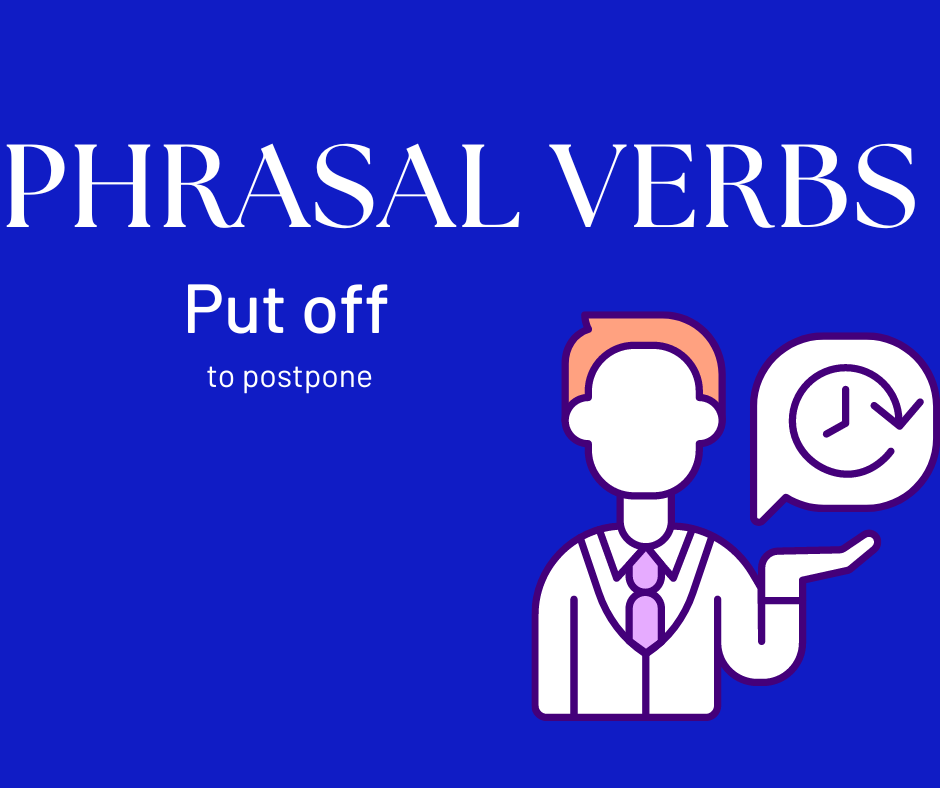
You learn the meaning of a phrasal verb as if it were a single word, as the meaning is usually very different from the original verb. For example, put typically means to place something somewhere, but put off means to postpone or delay doing something.
Luckily for language learners, there is always an alternative to a phrasal verb, so, if you can’t remember it use the alternative. The alternatives tend to be more formal than the phrasal verb, but the meaning remains the same:
I had to put off tomorrow’s meeting
I had to postpone tomorrow’s meeting
Now, Linguists estimate there are over 5000 phrasal verbs in English. Focus on learning the more common ones OR the ones you will use the most. Here are 5 common phrasal verbs used in business to get you started!
Here are 5 common phrasal verbs used in business to get you started!
- Follow up
- Sample Sentence: “After the meeting, I’ll follow up with an email outlining the action items.”
- Definition: To pursue or take further action regarding something discussed or initiated earlier, often in the context of a business interaction.
- Back up
- Sample Sentence: “Be sure to back up all important files to prevent data loss.”
- Definition: To make a copy of data or information for safekeeping, typically on a separate storage device or location.
- Run into
- Sample Sentence: “During the conference, I ran into an old colleague from my previous company.”
- Definition: To encounter unexpectedly, often referring to meeting someone or experiencing a problem or obstacle.
- Come up with
- Sample Sentence: “Our team needs to come up with innovative solutions to address this challenge.”
- Definition: To produce or generate, especially ideas, solutions, or plans in response to a problem or need.
- Look into
- Sample Sentence: “We’ll look into the issue and provide a detailed report by the end of the week.”
- Definition: To investigate or examine thoroughly, typically to gain understanding or resolve a problem or inquiry.
By incorporating these business-focused phrasal verbs into your communication, you’ll enhance your professional interactions and convey competence and fluency in the business environment.
Happy language learning!
Book your English Session today
-
False Friends: 14 Fascinating English and Spanish Examples that can Confuse Learners
One thing that often frustrates students is false friends. But what are they? These are words that look similar between the 2 languages, but can have radically different meanings. In this article, we will look at 14 of the most oftenly confused words 1. Actual/Actually vs Actual/ Actualmente This is a very common one. In
-
The Present Simple- In 3 levels
In English, when teaching grammar, we often drip feed the information, at each level adding a little more complexity and more uses. Here, let’s examine the uses of the present simple, with explanations appropriate for an elementary (A1-A2) speaker, an intermediate (B1-B2) speaker and an advanced speaker (C1 and C2) speaker. Level 1: Elementary Form:
-
10 Fascinating Spanish Loan Words in English
English is one of the most spoken languages in the world and is often considered the lingua franca (default language used in groups of people who do not share a first language) in many situations. But did you know English has borrowed a lot of words from other languages. Here 10 every-day non-food words we
-
Unlock Fluent English: 10 Tips to Transform Your English Pronunciation
Improving your pronunciation can seem like a daunting task, after all there are approximately 44 sounds in the English language (with some variation depending on accents). Thats not taking into account English being a language based on sentence stress. So how do you improve? Here are my top 10 tips to help improve this crucial
-
Phrasal verbs, what are they how to use them
Phrasal verbs. An essential, yet often hated part of learning English, but what are they? Simply put, a phrasal verb is a verb made up of 2 parts, the verb and the particle (which is usually a preposition). For example put off . You learn the meaning of a phrasal verb as if it were
-
The Conditionals: In 3 levels
The conditionals are a topic that many students struggle with. The structure can seem counterintuitive (the past for the future? That can’t be right!) So, let’s break these down to hopefully give you a better understanding of the conditional forms Level 1: Elementary There are 2 forms of the conditional to focus on at this
-
Why English Speakers are Difficult to Understand: Part 1 Sentence Stress
Have you ever wondered why first language English speakers are difficult to understand? There are several reasons for this which we will address in this series. The first element we will look at is sentence stress. What is stress? We can talk about stress in English in two ways: word stress and sentence stress. Word